
Graphene
Engineering performance at nano scale.
01ADVANCED MATERIALS / GRAPHENE OXIDE
Graphene Oxide (GO)
Oxygen-functionalized graphene for research and applications
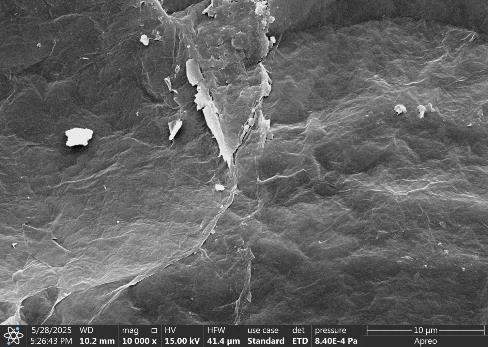
Graphene oxide is a single-atomic-layer material derived from graphite, rich in hydroxyl, epoxy and carboxyl groups. These oxygen-containing functional groups make GO hydrophilic and chemically versatile, with applications described in energy storage, filtration membranes, polymer composites and sensors.
Dispersion and functionalization
The datasheet describes GO sheets dispersed in water and polar solvents. Proper sonication is required before use.
Characterization
The supplied report discusses XRD, Raman spectroscopy, SEM and elemental analysis for evaluating layer structure, defects and functional groups.
Technical datasheet
| Property | Specification |
|---|---|
| Form | Dispersion of graphene oxide sheets |
| Particle size · D90 | 50–80 micron |
| Particle size · D50 | 50–20 micron* |
| Particle size · D10 | <20 micron |
| Color | Yellow-brown |
| Odor | Odorless |
| Dispersibility | Polar solvents |
| Solvent | Water |
| Concentration | 0.25–4 mg/ml |
| pH | 2–6 |
| Monolayer content · measured at 0.5 mg/mL | >45% |
Datasheet page 1; visible printed values are used. Proper sonication is required before use. *The D50 range is printed in descending order in the source and requires confirmation.
Elemental analysis
| Element | Reported content |
|---|---|
| Carbon | 49–56% |
| Hydrogen | 0–1% |
| Nitrogen | 0–1% |
| Sulfur | 2–4% |
| Oxygen | 41–50% |
Sample preparation: 2 g of 4 wt% GO in water, dried under vacuum at 60°C overnight. The narrative on page 2 separately lists approximately 25–30% oxygen; it is not reconciled with this datasheet range.
Available variants
Explore the variants listed in the Nanomatrix Materials advanced-materials catalogue.
02ADVANCED MATERIALS / REDUCED GRAPHENE OXIDE
Reduced Graphene Oxide (rGO)
A partially restored carbon network
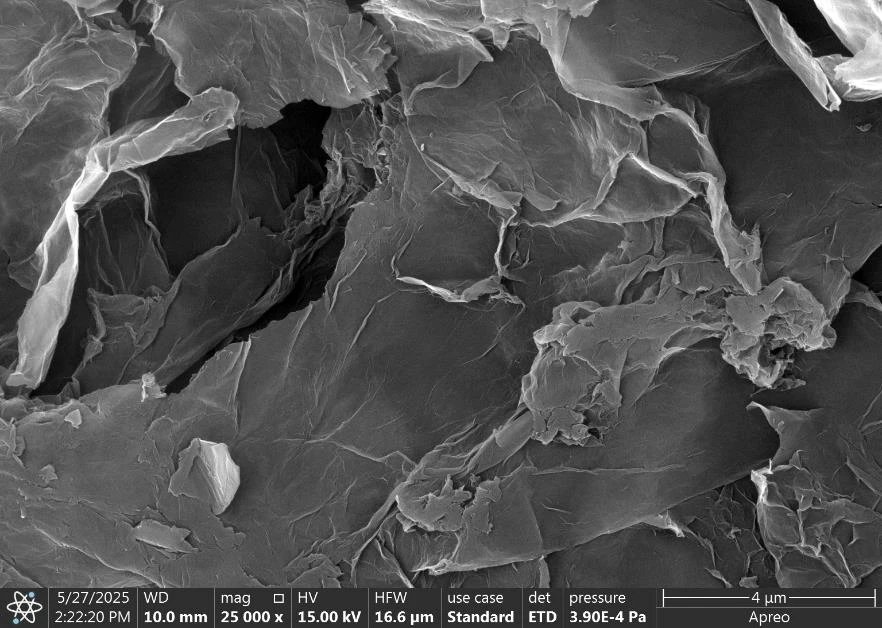
Reduced graphene oxide is produced through chemical, thermal or electrochemical reduction of GO. Oxygen-containing groups are partially removed, restoring part of the sp² carbon network. The supplied report describes higher electrical conductivity than GO while noting residual oxygen, structural defects and properties that depend on the reduction method.
Material transformation
Reduction partially restores the carbon network while retaining some defects and functional groups.
Research applications
The report lists energy-storage electrodes, sensors, catalyst supports, composites and environmental adsorbents.
Technical datasheet
| Property | Specification |
|---|---|
| Form | Reduced graphene oxide sheets |
| Particle size · D90 | 50 μm |
| Particle size · D50 | 20 μm |
| Particle size · D10 | <20 μm |
| Color | Black |
| Odor | Odorless |
| Dispersibility | Non-polar solvents |
| Solvents | DMSO, NMP, DMF |
| Concentration | 0.25–4 mg/ml |
| pH | — |
| Monolayer content · measured at 0.5 mg/mL | >35–55% |
Datasheet page 1; terminology and ranges are reproduced as printed. The reduced graphene oxide dispersion requires proper sonication before use.
Elemental analysis
| Element | Reported content |
|---|---|
| Carbon | 98% |
| Hydrogen | 0% |
| Nitrogen | 0.5% |
| Sulfur | 0.5% |
| Oxygen | 1% |
Sample preparation: 20 mg of rGO in DMF, dried under vacuum at 60°C overnight.
Available variants
Explore the variants listed in the Nanomatrix Materials advanced-materials catalogue.